




-
 Residential Roofing
-
 0 Comments
Infrared Commercial Roof Scans: How Hidden Moisture Is Located
An infrared commercial roof scan locates possible hidden moisture by recording temperature differences across a roof surface. Water trapped in insulation can change how a section of roof heats and cools, creating a thermal pattern that calls for closer investigation. The camera does not see through the membrane or prove that water is present. A reliable moisture map pairs thermal images with a visual inspection and physical checks at selected locations.
That distinction matters when an owner is deciding whether to repair a leak, remove wet insulation, install a TPO overlay, or replace a commercial flat roof. At Roof Care, we look at moisture as one part of the roofing decision, alongside the condition of the existing membrane, drainage, flashings, roof layers, deck, and proposed warranty. A scan is most useful when its findings lead to a clearly defined scope of work, not just a collection of colorful images.
For building owners and property managers in Longview, Tyler, Marshall, Kilgore, and nearby East Texas communities, the practical question is: where is the roof wet, how far has water traveled, and what must be removed before new roofing goes down? Infrared scanning can help narrow that search, but suspect areas still need confirmation.
What is an infrared commercial roof scan?
An infrared roof scan, also called a thermal roof survey, uses a camera that records the roof surface’s thermal radiation and displays differences in apparent temperature. The operator looks for patterns that may correspond to moisture beneath a membrane or within the insulation. The resulting image is a map of surface conditions at the time of the scan, not a photograph of the materials below.
On a suitable roof, moisture changes the way an area stores and releases heat. After solar exposure, a wet section may stay warmer than nearby dry sections as the roof cools. The operator identifies those differences, relates them to actual roof locations, and selects places for follow-up testing. A pattern near a drain might deserve attention, for example, but its shape and location alone cannot establish whether the drain is leaking.
Not every roof assembly produces a readable thermal contrast. Insulation type, roof covering, shading, weather, interior heat, rooftop equipment, and the placement of moisture within the assembly all affect the image. That is why an infrared survey is a diagnostic method, not a substitute for an experienced roofer examining the roof itself.
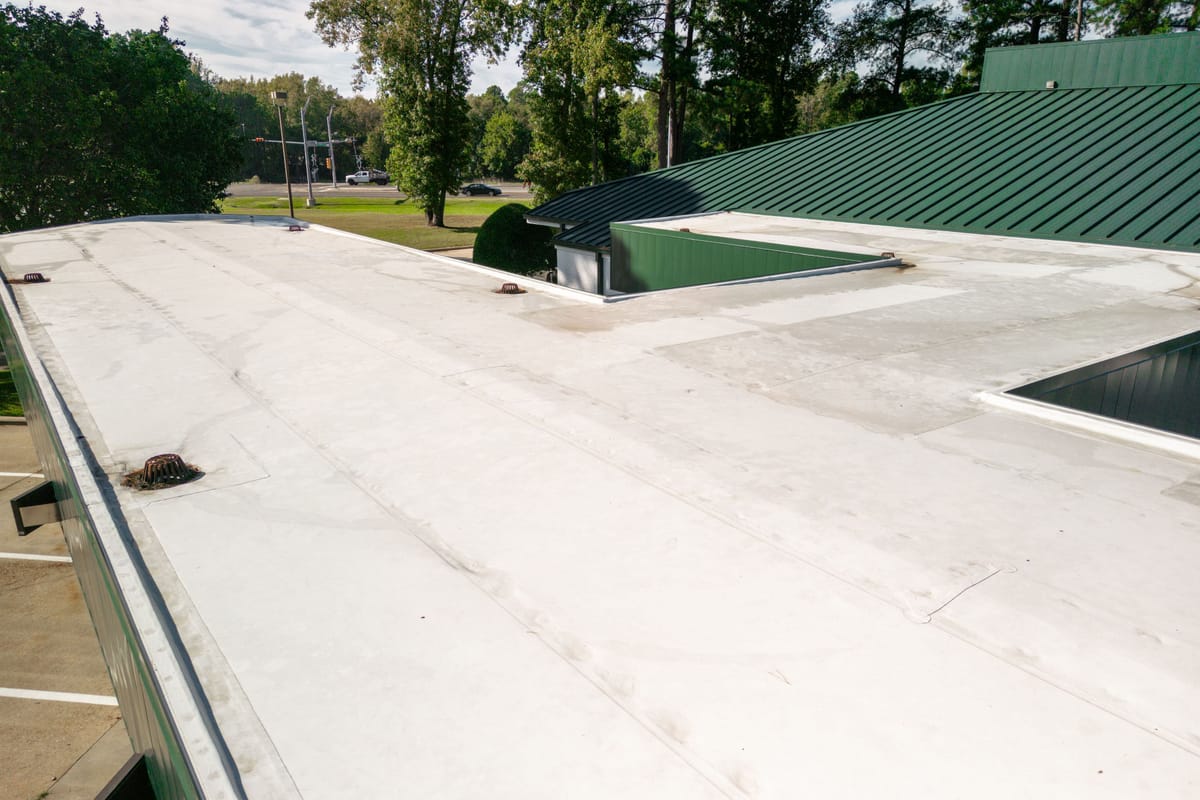
How hidden moisture is located, step by step
1. Establish what roof is being scanned
Before interpreting a thermal pattern, the inspector needs to understand the assembly. A TPO membrane over rigid insulation and a built-up roof with gravel are different starting points. Previous repairs, additional roof layers, changing insulation thicknesses, and areas over conditioned or unconditioned space can also affect surface temperature.
Roof plans, maintenance records, leak reports, and accounts of past repairs help direct the inspection. If a tenant reports water near an HVAC unit, that information belongs on the roof plan. Interior staining can help identify an area to investigate, although water may have traveled before it became visible inside.
2. Inspect visible conditions in daylight
A visual inspection identifies issues thermal imaging cannot explain on its own: open seams, punctures, displaced flashing, failed details at penetrations, deteriorated parapet edges, debris around drains, and areas where water collects. The inspector also notes equipment, shadows, patches, and changes in surface material that could create misleading temperature differences later.
This step can change the entire investigation. If a flashing detail is visibly open, it needs attention whether or not a thermal image shows a warm area nearby. Conversely, an apparent warm area without an obvious opening still needs to be checked, not dismissed.
3. Choose a useful thermal window
A common approach is to survey a roof after it has received daytime sun, when wet and dry materials may cool at different rates. The best time depends on the assembly and conditions that day. Cloud cover, wind, shade, standing water, recent rainfall, and heat from rooftop equipment can make patterns harder to interpret.
A scan taken at the wrong time can miss affected areas or make ordinary roof features look suspicious. Scheduling is therefore part of the diagnostic work. The operator should know what conditions the roof experienced before the images were captured and note areas where conditions limit confidence.
4. Capture and locate thermal anomalies
During the scan, the operator compares patterns across the roof rather than treating every color change as moisture. Suspect areas are related to fixed features such as drains, parapets, curbs, and roof sections so a crew can find them again. Visible photographs and notes help connect a thermal image to the actual surface.
The map should distinguish between an approximate area flagged for testing and an area where wet materials have been confirmed. That distinction matters when an owner uses the report to request bids. A bidder needs to know whether a marked boundary represents an estimate from imaging or a verified removal area.
5. Confirm what is beneath the membrane
Physical verification is the decision point. Depending on the assembly and scope, a roofing professional may use appropriate moisture testing or carefully selected core cuts to examine the materials. A core can show the roof’s layers and the condition of insulation at that particular location. It does not, by itself, establish the condition of every adjacent square foot, so test locations must be chosen thoughtfully. Any test opening must be properly repaired.
Verification can also show that a thermal anomaly has another cause. Avoiding unnecessary removal is as important as finding wet insulation. For a closer look at how roof openings inform an overlay decision, read our guide to using core cuts to evaluate wet insulation before a TPO overlay.
6. Turn the findings into a roofing scope
The final question is what to do with the information. A useful recommendation identifies the roof areas inspected, the locations tested, the limits of the survey, and how confirmed wet areas affect the proposed work. It also connects moisture findings to the likely entry points. Replacing insulation without correcting an open flashing or failed penetration detail leaves the underlying leak problem in place.
What thermal images can and cannot tell an owner
Thermal imaging is good at finding areas that warrant investigation. On a suitable roof under useful conditions, it can help a crew survey a broad surface and decide where to test instead of making openings at random. It may also reveal a pattern extending beyond the place where water first appeared indoors.
Thermal imaging cannot determine the repair scope by itself. A surface temperature difference does not tell you how much insulation is wet, whether the deck is affected, how water entered, or whether an overlay meets project requirements. A thermal image also cannot guarantee that every damp area will be visible. A small, recent, deeply located, or thermally masked wet spot may not produce a distinct pattern.
Common sources of misleading patterns include:
- Shadows and solar exposure: Roof areas heated for different lengths of time may cool differently.
- Different materials: A patch, coating, or change in insulation can alter surface temperature.
- Rooftop equipment: Exhaust, HVAC operation, and equipment shadows can affect nearby readings.
- Standing water: Water on top of the roof changes the thermal image and should not be confused with trapped moisture below it.
- Building conditions: Differences in heat below the deck can affect what appears at the roof surface.
These are reasons to investigate a pattern carefully, not reasons to ignore scanning. The value comes from combining methods and recording which conclusions have been physically checked.
Infrared scanning versus other roof inspection methods
Each method answers a different question. For commercial roof moisture investigations, the strongest approach often uses several methods in sequence rather than asking one tool to do everything.
| Method | Useful for | Key limitation |
|---|---|---|
| Visual roof inspection | Finding visible damage, drainage problems, failing flashings, and likely leak entry points. | Cannot reliably show the condition of insulation concealed by an intact membrane. |
| Infrared survey | Locating surface temperature patterns that may guide testing across a roof area. | An anomaly is not proof of moisture, and some assemblies or conditions limit detection. |
| Targeted moisture testing | Checking suspect and comparison locations with methods appropriate to the roof assembly. | Results depend on the material, method, and exact test locations. |
| Core cuts | Seeing the layers and checking material condition at selected points. | A core represents a specific location and creates an opening that must be repaired. |
A visual inspection comes first in most practical decisions because the leak source still needs to be addressed. Scanning can help narrow the area of concern. Testing and cores then support decisions about material removal. None of these methods makes the others unnecessary.
Why moisture mapping matters before a TPO overlay
An overlay places a new roof system over an existing roof rather than removing the entire old assembly. It can be an economical option when existing conditions, roof layers, applicable requirements, and the proposed manufacturer-approved assembly allow it. But an overlay should not be treated as a way to conceal known wet insulation. Areas confirmed to be wet need a defined plan for removal and replacement before they are covered.
This is where a moisture investigation can influence a commercial flat roof replacement budget. If wet materials are isolated, a proposal can identify those areas and separate their removal from the broader overlay scope. If moisture is widespread, or if the roof and deck have other significant problems, a larger replacement scope may be appropriate. The answer also depends on drainage, flashing conditions, attachment, and warranty requirements, not simply the percentage of roof that appears warm in an image.
We typically evaluate economical overlay options for commercial owners when the roof has one existing layer and the assembly is suitable. A common proposed configuration uses a 1/2-inch cover board and 60 mil TPO, with removal of wet insulation itemized if needed. See our discussion of TPO overlay versus full tear-off decisions for the broader factors that go into that choice.
A roofing estimate is not a moisture survey. Roof Care’s Instant Estimate Tool dynamically calculates pricing for commercial TPO roofing systems alongside residential roofing products. It is useful for an initial budget; hidden moisture, insulation removal, deck condition, and final assembly details require a site-specific evaluation before the scope and price are finalized.
Where should an inspector look closely?
Moisture does not always remain beside its entry point. It may move within or along roof layers before it reaches a place where it can be observed. That is why a leak report and a thermal pattern should be read together, not assumed to describe the same exact location.
- Penetrations and equipment curbs: Check the flashing around pipes, conduits, supports, and HVAC equipment. Service work can also disturb an existing detail.
- Parapets and roof edges: Water entering at a wall or edge detail may affect material farther inward. Review counterflashing and coping along with the roof membrane.
- Drains and low areas: Inspect the condition of the drain connection and surrounding surface. Clearing debris and understanding how water leaves the roof are part of the investigation.
- Membrane seams and prior patches: Look for openings, damaged repairs, and changes in material that may affect both water entry and thermal appearance.
- Reported interior leaks: Mark the room and ceiling location, then compare that information with rooftop features rather than assuming the opening is directly overhead.
For roofs with recurring issues at utility penetrations, our article on TPO leaks at conduits and gas lines explains why those details deserve close attention. Good drainage documentation matters too, especially when overflow scuppers are part of the roof design.
A Longview shopping center shows why the whole roof assembly matters
Our 68,000-square-foot Longview shopping center project began with a failing built-up roof surfaced with pea gravel. The owner’s initial concept called for a tear-off, 4.5 inches of ISO insulation, and a new 60 mil TPO membrane. We evaluated the existing roof and proposed an alternative: scrape the pea gravel, then install a 1/2-inch HD ISO insulation cover board and 60 mil TPO over the single existing roofing layer. That approach saved 28% compared with the original concept.
The project also required more than a membrane decision. Mansard wall supports had created leaks. Our crew built up those areas with plywood and nailers and installed prefabricated penetration pockets to address the water intrusion. The work included new parapet caps, counterflashing, walkpads, pipe stands for gas and electrical lines, mansard wall panels, and TPO drip edge. The completed roof received a 20-year No Dollar Limit manufacturer warranty, with a possible five-year extension tied to annual inspection and maintenance.
This project illustrates the value of examining the existing assembly and correcting actual leak details before settling on a replacement design. It is not an example of an infrared survey, and its cost savings should not be attributed to scanning. The lesson for any moisture investigation is the same: use the findings to inform a complete roof scope, not to make the membrane decision in isolation.
When is an infrared roof survey worth considering?
Not every roof concern calls for a thermal scan. A clearly visible, isolated membrane puncture may be straightforward to inspect and repair. A scan becomes more useful when the extent of concealed damage could change a significant spending decision.
- Recurring leaks: Repairs have addressed visible defects, but interior water still appears.
- Unclear damage extent: The owner knows water entered but cannot tell how far it traveled beneath the membrane.
- Overlay planning: The contractor needs to identify suspect wet areas before proposing to cover an existing roof.
- Replacement bidding: A clearer picture of affected areas can help define removals and reduce ambiguity between proposals.
- Property evaluation: A prospective buyer or owner planning capital work wants a closer look at a low-slope roof with a leak history.
- Storm follow-up: Visible damage or new leaks after severe weather suggest the roof assembly needs more than a surface check.
The first step is still to discuss the roof history and inspect conditions. If scanning would not materially improve the repair or replacement decision, it should not be added simply because the equipment is available.
Best practices for building owners and facility teams
Keep the leak record specific
Record when water appeared, which rooms were affected, and what was happening outside at the time. Include photographs of interior staining and note previous repair locations. A dated record gives the inspector a better starting point than a general report that the roof leaks somewhere above a tenant space. Our guide to commercial roof maintenance logs outlines what to track over time.
Ask for a map that separates suspicion from confirmation
When reviewing a thermal survey, ask which boundaries came from imaging, where verification took place, and what was found at each test point. A map of suspected wet areas is useful, but it should not be silently converted into a fixed removal quantity. Ask how areas between test points will be handled if additional wet material is exposed during construction.
Fix the entry point, not just the stained area
New insulation and membrane will not solve a leak if water can still enter at a parapet, curb, drain, or penetration. The proposed repair should explain how those details will be corrected. On a TPO roof, seam and flashing work must fit the existing system and condition. See our explanation of why TPO seams fail and how commercial repairs are made.
Make the roof scope understandable to every bidder
If several contractors are pricing a project, provide the same roof plans, survey information, known leak history, and testing results to each. Ask them to distinguish base work from allowances or unit pricing for concealed wet insulation. That makes proposals more useful than a simple comparison of total prices that may assume different removal quantities or roofing assemblies.
Plan around building operations
Access to tenant areas, roof hatches, equipment, and testing locations may need coordination. For occupied properties, establish where openings can be made, who must be notified, and how the roof will be left watertight after testing. Our in-house commercial roofing mechanics can coordinate inspection findings with repair and replacement planning around the building’s schedule.
Questions to ask about a proposed infrared scan
- What roof information and leak history will be reviewed before the survey?
- What conditions are needed for useful thermal images on this particular roof?
- Will the work include a daylight visual inspection?
- How will anomalies be marked so they can be located for testing and repairs?
- Which findings will be physically checked, and who repairs any test openings?
- Will the report distinguish suspected moisture from confirmed wet materials?
- How will the results change the repair, overlay, or replacement proposal?
These questions are more valuable than asking whether a provider owns a thermal camera. The method is only as useful as the inspection, interpretation, verification, and roofing decisions that follow.
Frequently asked questions
Can an infrared camera see water under a TPO membrane?
No. It detects differences in apparent surface temperature. Moisture beneath TPO may contribute to a detectable pattern under suitable conditions, but the suspected area needs follow-up testing before it is treated as wet insulation.
Will an infrared scan find the exact point where my commercial roof leaks?
Not necessarily. It may show a suspect area affected by moisture, while the entry point lies elsewhere. Inspect seams, flashings, penetrations, parapets, and drainage alongside the thermal results. An indoor drip location is not a reliable map of the opening above.
Can a roof be scanned during the day?
Thermal imaging can be performed at different times, but a common approach for locating moisture in suitable roof assemblies relies on differences that become apparent as a sun-heated roof cools. The operator should choose the timing based on the roof and conditions, not assume any daytime image will answer the question.
Does a warm area always mean wet insulation?
No. Different materials, shadows, equipment, surface water, and heat from inside the building can also create temperature differences. The purpose of the image is to identify a place to investigate. Physical verification is what helps establish the condition of the roof layers.
Does a clean scan prove the roof is dry?
No. A roof may not produce clear contrast because of its construction, weather conditions, or the location and extent of moisture. A clean-looking image should be considered with leak history, visual findings, and testing where the risk justifies it.
Should wet insulation be left in place under a new TPO roof?
Confirmed wet insulation needs to be addressed in the proposed scope, rather than simply covered by a new membrane. The extent of removal and the replacement assembly should be determined from inspection and testing, along with the applicable project and manufacturer requirements.
Can an infrared survey determine whether I need a full tear-off?
It can inform the decision but cannot make it alone. Roof layers, membrane condition, deck condition, drainage, attachment requirements, and the amount and distribution of wet material all matter. A limited wet area does not automatically justify an overlay, and a thermal anomaly does not automatically require a full tear-off.
Is infrared scanning the same as an online TPO estimate?
No. An online estimate helps establish a preliminary roofing budget. An infrared survey investigates roof conditions that may affect the work. Neither replaces an on-site assessment of the existing assembly when a final commercial roof scope is being prepared.
Make the moisture map useful
The most valuable infrared commercial roof scan does three things: it identifies suspect areas, prompts well-chosen verification, and helps turn confirmed conditions into a clear repair or replacement plan. For an owner, the goal is not to collect thermal images. It is to avoid leaving wet materials beneath a new roof, avoid removing sound materials without cause, and correct the details that allowed water in.
For commercial roofs in Longview, Tyler, Marshall, Kilgore, and surrounding East Texas communities, Roof Care can help evaluate leaks, insulation concerns, and options for repair or TPO replacement. If you are starting with a budget, use our Instant Estimate Tool for dynamically calculated commercial TPO pricing alongside residential roofing options, then contact us at (903) 399-5403 or contact@roof.care to discuss the roof’s actual condition and the next steps.

